Decorate Like a Pro: the 3-5-7 Rule Guide for Stunning Rooms
Ever wonder why some rooms in high-end magazines look effortlessly balanced, warm, and inviting, while others feel stiff or cluttered? The secret isn’t an unlimited budget or high-end vintage antiques. Professional interior designers rely on simple visual formulas to create balance and rhythm. Chief among these layout secrets is the 3-5-7 rule guide, a powerful approach to arranging furniture, accessories, lighting, and wall art.
By using odd numbers—specifically groups of 3, 5, or 7—you automatically force the human eye to move around an arrangement, creating visual intrigue. Whether you are styling a coffee table, setting up a gallery wall, or decorating a living room mantle, following the 3-5-7 rule guide will instantly elevate your home decor game.
What Is the 3-5-7 Rule in Interior Design?
At its core, the 3-5-7 rule guide is an extension of the classic “rule of odds.” In visual design, even numbers create symmetry, but odd numbers create dynamic tension and visual motion. When you look at an even pair of objects, your brain quickly pairs them up and stops processing the scene. When you view an odd-numbered grouping, your eyes naturally wander across the arrangement to find the visual center.
| Grouping Size | Best Suited For | Ideal Decor Items |
|---|---|---|
| Group of 3 | Small surface areas (Coffee tables, nightstands, entry console tops) | 1 tall vase, 1 small candle, 1 short decorative bowl |
| Group of 5 | Medium surface areas (Fireplace mantels, large dining tables, sideboards) | 2 stackable books, 1 tall ceramic jug, 1 accent sculpture, 1 small plant |
| Group of 7 | Large surface areas & focal points (Gallery walls, wide open shelving, outdoor patios) | A mix of 7 varied frame sizes, varied ceramic pots, or mixed textures |
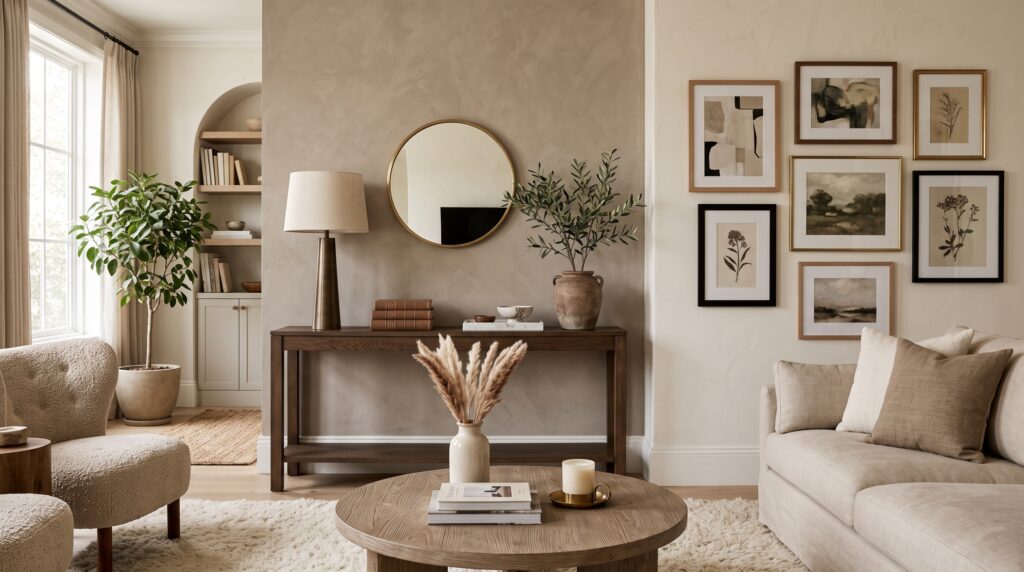
Why Odd Numbers Work: The Science of Visual Rhythm
Why does the 3-5-7 rule guide work so effectively across every interior design style—from sleek modern minimalism to warm, earthy organic spaces? It all comes down to human psychology, visual tracking, and how our brains naturally process shapes and patterns.
When you arrange items in even numbers (like 2 candles or 4 frames), your brain automatically pairs them up to create balance. This visual symmetry allows your mind to process the entire arrangement almost instantly, causing your eyes to quickly look away. Odd numbers, on the other hand, disrupt this instant grouping process and create a subtle sense of energy that makes a room feel alive.
- Visual Friction & Engagement: Odd-numbered groupings create a small amount of visual “friction.” Because your brain cannot easily pair up the items, your eyes are forced to move across each piece individually, encouraging your gaze to linger on the display for longer.
- Natural Organic Asymmetry: Perfect side-by-side symmetry rarely occurs in nature. Plants, trees, and rock formations grow in organic, asymmetrical clusters. By styling decor in groups of 3, 5, or 7, you mimic these natural patterns, making the arrangement feel relaxed, effortless, and welcoming rather than overly stiff or clinical.
- Built-in Center Focal Point: An odd-numbered arrangement always naturally produces a middle anchor piece. Whether you have 3 objects on a coffee table or 7 frames on a feature wall, there will always be a clear center item flanked by an equal number of supporting pieces on either side. This allows you to easily establish height, balance, and depth without guessing.
- Movement and Depth Perception: When you look at an odd grouping arranged in varying heights, your vision traces a fluid “zigzag” line across the objects. This dynamic eye movement tricks the brain into perceiving more physical depth, making small tables, narrow mantels, or cramped shelves feel significantly larger and more dimensioned.
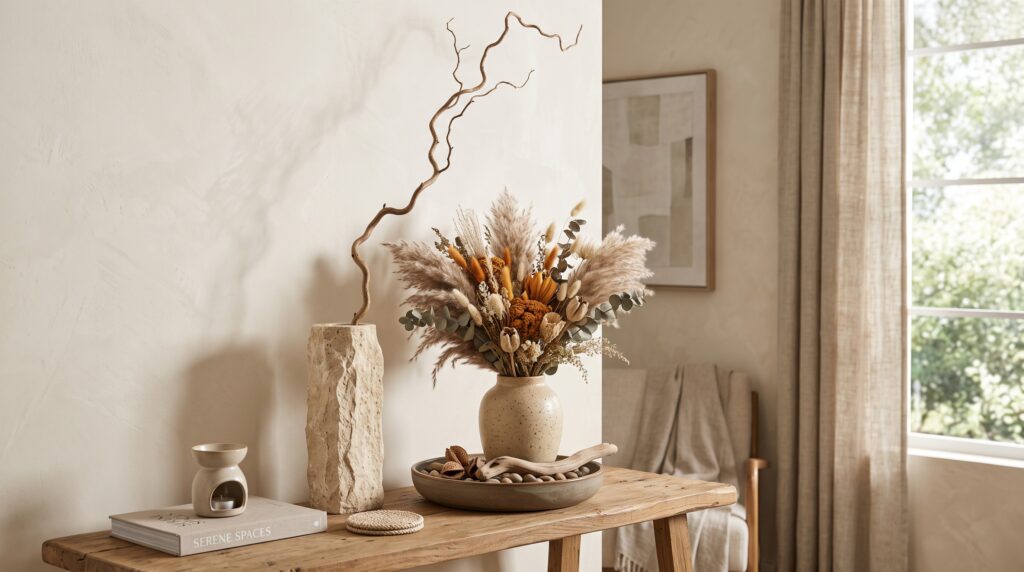
How to Apply the 3-5-7 Rule Guide in Every Room
1. The Grouping of 3: Small Surfaces & Vignettes
The trio arrangement is the foundation of the 3-5-7 rule guide. It works best on coffee tables, bedside nightstands, and bathroom vanities.
To master a trio grouping, mix three primary variables: Height, Shape, and Texture.
- Height: Combine one tall item (a tapered candle or stem vase), one medium item (a small sculpted figure), and one low item (a flat tray or coaster stack).
- Shape: Pair round objects with geometric, linear pieces to prevent visual monotony.
- Texture: Contrast smooth ceramic with raw wood, ribbed glass, or woven rattan.
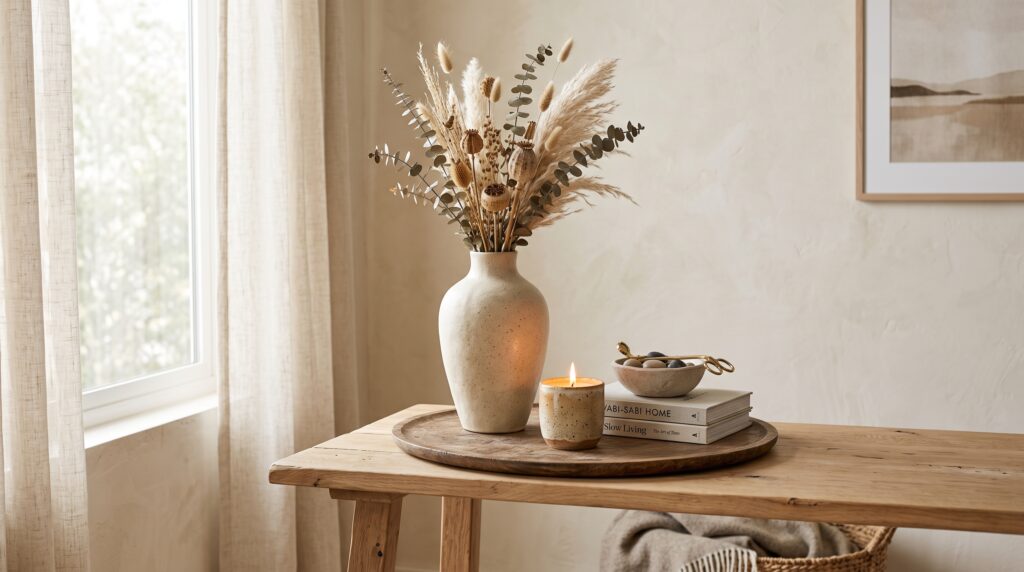
Not sure your current coffee table styling is working? Check our guide on stop styling your coffee table wrong for 15 quick fixes, or take the 5-second coffee table test to see what guests notice first.
2. The Grouping of 5: Mantels, Buffets & Credenzas
When working with wider horizontal surfaces like a fireplace mantel or dining sideboard, three items can leave too much empty dead space. Stepping up to five pieces fills the expanse while keeping the composition relaxed.
A classic 5-piece arrangement formula includes:
- One large central art print or mirror rested against the wall.
- Two tall candlestick holders of slightly differing heights on the left.
- One medium ceramic bowl filled with wooden beads on the right.
- One small trailing potted plant placed near the bowl to ground the edge.
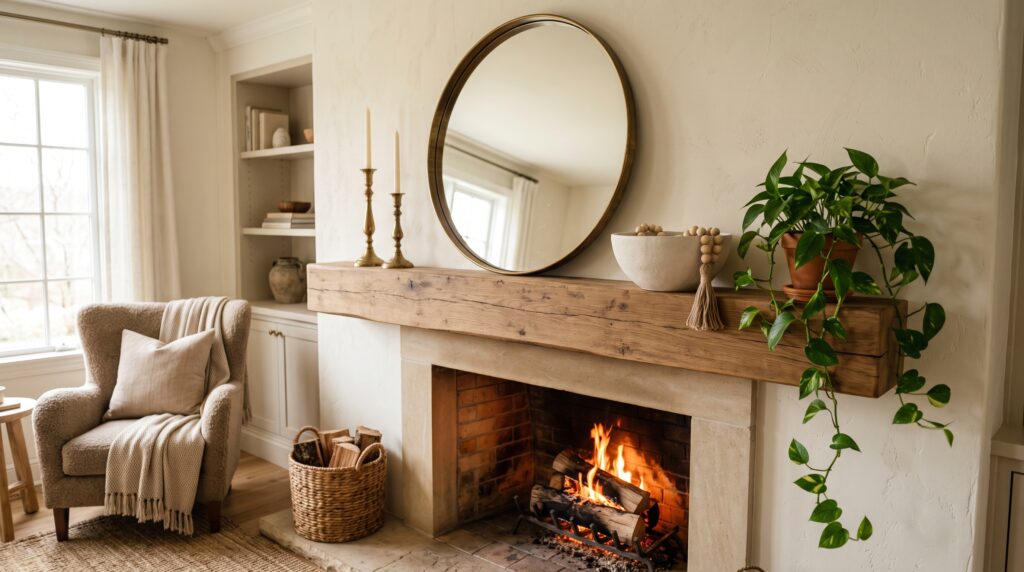
For more mantel and surface styling inspiration, browse our 7 proven tips for cozy room decor that actually work.
3. The Grouping of 7: Gallery Walls & Open Shelving
Large feature walls and built-in shelving units require scale. Arranging seven items allows you to create depth across wide spaces without making the room feel disorganized.
For gallery walls, choose seven frames of varying sizes but stick to two consistent finish tones (e.g., light oak and matte black) to maintain cohesion. On open kitchen shelves, mix seven functional and decorative items like ceramic mugs, wooden cutting boards, woven baskets, and stoneware crocks.
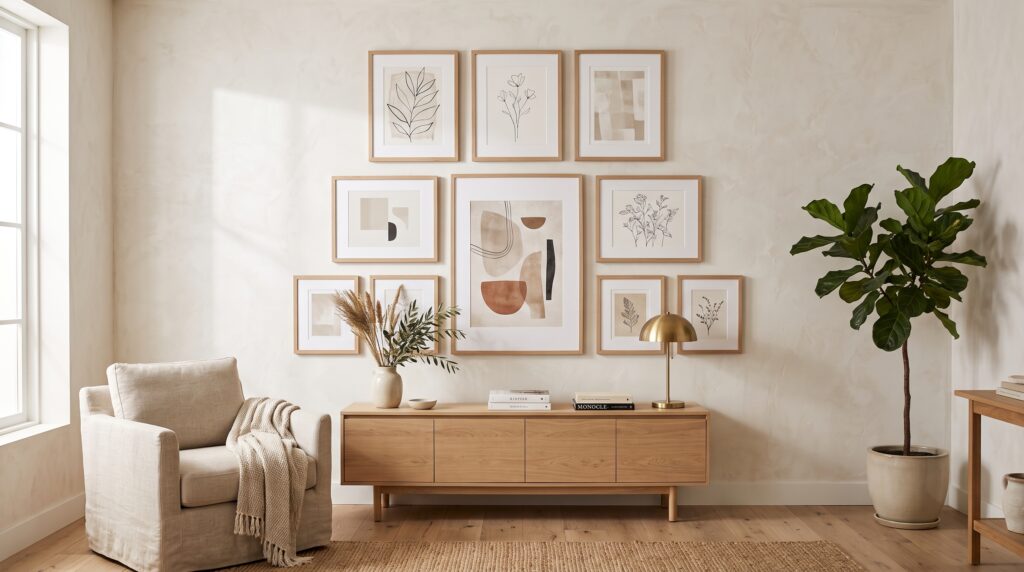
For a deeper dive into frame sizing and finishes, see our full mix & match frames guide for 2026 wall decor.
Essential Rules to Pair With the 3-5-7 Formula
To get maximum impact from the 3-5-7 rule guide, combine it with these core design principles:
The Triangle Composition Technique
Never line up your 3, 5, or 7 items in a straight row. Instead, arrange them in a triangular formation, staggered back to front. Place the tallest item at the apex of your triangle and place shorter items forward and to the sides.
The Power of Layering
Overlap edges slightly rather than giving every object its own isolated island of space. Let the edge of a small photo frame overlap the corner of a large canvas, or set a small candle directly on top of a stack of two coffee table books.
Quick Reference: Applying the 3-5-7 Rule Guide
| Room Location | Recommended Odd Count | Primary Anchors | Secondary Details |
|---|---|---|---|
| Living Room Coffee Table | Group of 3 | Stack of coffee table books | Small brass bowl, scented candle |
| Fireplace Mantel | Group of 5 | Leaning artwork, tall vase | Taper candles, small greenery pot |
| Entryway Console | Group of 5 | Table lamp, large round mirror | Decorative tray, catchall bowl, small sculpture |
| Main Gallery Wall | Group of 7 | 3 Large framed art prints | 4 Medium accent photos |
| Kitchen Open Shelves | Group of 7 | Cookbooks, wooden boards | Stoneware crocks, glass jars, stemware |
Frequently Asked Questions
Can I mix different colors and materials in one grouping?
Yes! In fact, mixing materials like wood, matte ceramic, polished metal, and fresh greenery makes the 3-5-7 rule guide work even better. Just keep one unifying element constant, such as a repeating color accent or consistent wood tone.
Do I have to use odd numbers everywhere in my home?
Not always. Symmetry (even numbers) works wonderfully for formal, structured spaces like matching nightstands on either side of a bed or a pair of identical armchairs in a sitting room. Use odd numbers on surface decor, vignettes, and displays to inject personality and warmth.
What if my coffee table is too small for 3 items?
If surface space is extremely limited, scale down the size of the objects rather than reducing the count. Use a tiny matchbox, a compact candle, and a small coaster rather than large oversized pieces.
Transforming Your Space with Balanced Design
Decorating your home doesn’t require complex design rules or endless trial and error. By applying the 3-5-7 rule guide, you can confidently arrange surfaces, style accent furniture, and build captivating wall displays that look intentional, harmonious, and curated.
Start small with a quick 3-piece refresh on your coffee table or nightstand today. Once you see how quickly odd-numbered arrangements bring balance and life into your home, step up to 5-piece and 7-piece displays on your mantels and accent walls. With this simple formula in hand, creating a beautifully balanced, professional-looking space becomes second nature.